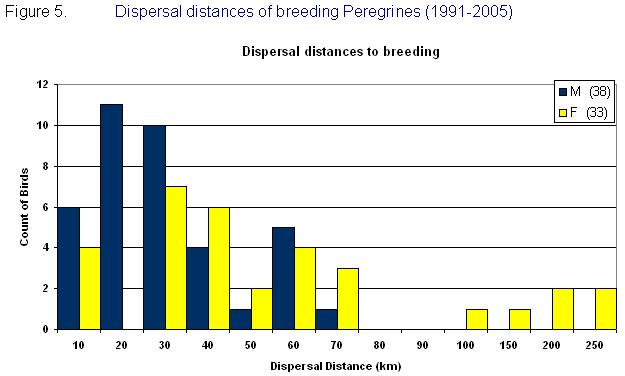
Females are travelling consistently further than males to breed. This trend has been observed in most bird of prey species. We have found, on average, females are moving ~70 km to breed compared to an average of only ~30 km for males. Curiously we have also found six females and two males breeding at the same site at which they were raised. This is a phenomenon referred to as "queuing" and serves as the only example of co-operative breeding found in Australian Peregrines.
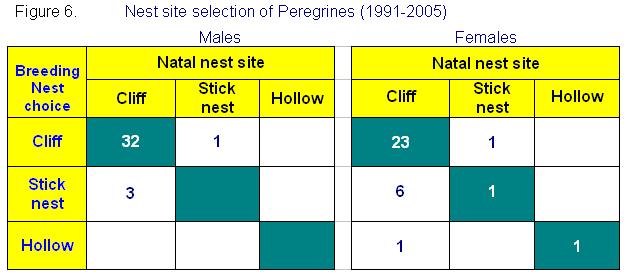
For the project since 1994 the sighting and individual identification of 71 banded adult Peregrines is starting to show that there is a predictable strong preference for cliff nests. Males appear to be more conservative in their nest selections. There also appears to be a surprising amount of interbreeding between the birds of cliff origin and those from stick nests. The nest site choices of offspring from tree hollows remains largely unresolved with only the one sighting so far. Surveying of these populations remains a high priority for the ongoing work of the project.