The VPP is often called upon to provide advice on how to best manage or relocate a raptor nest site. Whilst we have had considerable success in designing and installing nest boxes for cliff faces and then having Peregrines move into them from several hundred metres away. The VPP is often called in when Peregrines are found nesting in heavy industrial locations. Often these require some direct intervention to secure a more permanent nesting site.
Case Study - Site #150 & 160
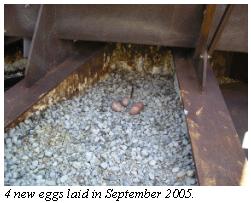
In late November 2003 the VPP was contacted by Royal Melbourne Zoo about an injured Peregrine found at Exxon/Mobil's Altona refinery. The bird (an adult male) was thought to have been breeding at the site on an old catalytic converter (cracking) tower. The bird had concussion and mild injuries which healed quickly and it was banded and released within a week. Released in north Werribee it was found breeding at the Altona site in 2004, raising three young. The nest site was modified by placing a thicker layer of gravel to improve drainage and a sheet of tin was secured above the site to deflect overhead rain and water runoff. Peregrines laid four eggs in 2005.
In mid 2005 a pair of Peregrines were sited at Exxon/Mobil's Longford gas plant, near Sale. A site inspection revealed a pair of Peregrine falcons were in fact occupying the site for the first time. They also that did not have a suitable location to lay eggs but were certainly showing all the normal signs of preparing to lay on a tower that was scheduled for major maintenance during the upcoming breeding season. So a nest box was quickly built and installed on a neighbouring tower away from direct disturbance by the proposed maintenance work. By early September the Peregrines were seen inspecting the new box. Finally in late October two eggs were discovered in the nest box.
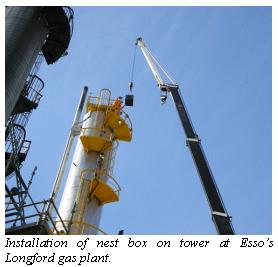
Quick action by the VPP and Esso Longford staff ensured that the box was constructed and installed in the shortest time possible. This allowed the Peregrines the most time to accept this new structure and adopt it for nesting purposes.
In both of these situations, experienced advice from the Victorian Peregrine Project and a co-operative approach by staff and managers ensured positive results with minimal disruption to normal working activities. Unfortunately both sites failed to hatch their eggs (4 at Altona and 2 at Longford).